Hyundai has unveiled its production-ready Ioniq 3, a compact five-door electric vehicle designed to challenge established players in the growing small EV market. The Korean automaker positioned the new model as an “aero hatch” that’ll compete directly with the Renault 5, Mini Electric, and upcoming Cupra Raval when it reaches UK dealerships later this year.
The Ioniq 3 measures 4.15 meters long – placing it between traditional B-segment and C-segment vehicles. But Hyundai’s targeting the smaller market segment based on the car’s power output and range capabilities.
The new model will share its 400V E-GMP platform with Kia’s upcoming EV2, creating internal competition within the Hyundai Motor Group.
Sharp Design Links to Concept Car
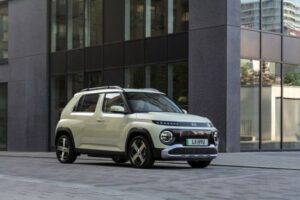
The production Ioniq 3’s exterior styling draws heavily from last year’s Concept 3 show car. Hyundai removed the concept’s rear-hinged doors and bumper-mounted digital display but kept the core design language intact.
Key styling elements include a curved bonnet line, raked roofline, and pinched rear glass section. A prominent ducktail spoiler splits the rear window area.
Hyundai describes the design approach as its “art of steel” philosophy – using minimal lines to create visual impact. The Ioniq 3 features the brand’s signature pixel-style LED lighting at both front and rear.
Interior designers took inspiration from household furniture, particularly 1970s Italian fabrics. The cabin focuses on reducing driver distractions while maximizing space efficiency.
Hyundai claims best-in-class passenger room plus a 322-liter boot that expands to 441 liters with an underfloor “Megabox” storage system. Higher trim levels get heated and cooled “relaxation” seats.
The Ioniq 3 becomes the first European Hyundai to use Google’s infotainment platform. Central touchscreens of 12.9 or 14.6 inches will run Android Automotive-based Pleos software for improved integration.
Two Battery Options Target Different Needs
Built on Hyundai’s proven E-GMP architecture, the Ioniq 3 offers two distinct powertrain configurations with ranges up to 308 miles.
Standard Range models pair a 42.2kWh battery with a 145bhp front motor. This setup delivers 214 miles of range and accelerates from 0-62mph in 9 seconds.
Long Range versions use a smaller 135bhp motor but pack a larger 61kWh battery pack. The configuration prioritizes efficiency over performance – reaching 62mph in 9.6 seconds while achieving up to 308 miles of range.
Hyundai calls the Long Range’s 308-mile capability “class-leading” – reinforcing the company’s view that the Ioniq 3 competes in the B-segment rather than moving up-market.
DC fast-charging specifications haven’t been confirmed yet. However, both battery packs will charge from 10-80% in approximately 30 minutes and support AC charging at up to 22kW.
The Ioniq 3 includes Plug & Charge capability that automatically handles payment authentication at compatible charging stations. Vehicle-to-load functionality lets owners power external devices using the car’s battery.
Pricing Strategy Targets Mass Market
Official pricing remains unannounced, but industry sources expect the Ioniq 3 to start around £25,000 after government incentives or manufacturer discounts. This positioning would place it alongside the Cupra Raval, Kia EV2, and VW ID.Polo when those models arrive.
Full specification details are still being finalized. Hyundai has confirmed a range-topping N-Line trim featuring 19-inch wheels, gloss black exterior accents with red details, and sport-focused interior touches.
Following Hyundai’s established EV lineup structure, expect additional Advance, Premium, and possibly Ultimate trim levels with less aggressive styling.
Available options will include a Bose sound system, ambient lighting, and smartphone-based digital keys. Driver assistance features range from Highway Assist 2.0 – which manages speed and lane positioning – to adaptive LED headlights.
The Ioniq 3 will be manufactured at Hyundai’s Izmit facility in Turkey specifically for European markets.
First UK deliveries are scheduled for the second half of 2024.