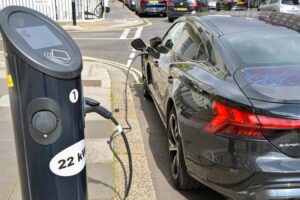
Ordnance Survey and Transport for the North have launched a mapping project to help councils install EV chargers where they’re needed most across northern England.
The collaboration targets the regional charging divide that’s left parts of the country behind in charger provision. It also addresses local inequity in charger access.
The project covers 6.4 million households from Cumbria and Northumberland to Cheshire and Greater Manchester.
The mapping shows which homes have driveways or off-street parking – and which don’t. This data helps identify where public chargers are most critical for drivers who can’t install home charging equipment.
Drivers without private parking face major disadvantages when switching to electric cars. The tool gives councils precise data to target public charger installations where they’ll have the biggest impact.
Northern England Faces Charging Infrastructure Gap
Transport for the North’s recent EV State of Play report revealed stark regional differences in charging access.
Forty-seven percent of northern households lack driveways – compared to the national average of 40%.
The north also shows high car dependency, making council-backed public charging essential for EV adoption.
The new analysis uncovered dramatic local variations within the region. Some areas see 97% of homes with driveways or off-street parking. Others have just 2%.
One Sunderland road contains over 500 homes but only 12% have driveways.
A North West street has more than 190 houses – with just one driveway.
John Kimmance, chief customer officer at Ordnance Survey, said the partnership provides "vital insight which will help local authorities in the region plan their EV infrastructure more effectively."
“While this will benefit the public in ultimately gaining greater access to EV charge points in the future, it will also potentially save local authorities thousands of pounds.”
Public Charging Growth Still Falls Short
Charger access and public charging costs remain major barriers for drivers without home charging options. Councils and private operators continue installing kerbside devices in residential areas, but numbers need substantial growth.
Public chargers in northern England have doubled over two years to more than 17,500 devices.
Transport for the North estimates that figure must increase tenfold by 2030 to meet projected demand.
The Local Electric Vehicle Infrastructure fund now provides £109 million across the region. The funding supports local authorities improving public chargepoint provision.
Machine learning technology powered the mapping analysis, creating detailed driveway data for the entire northern region. The tool represents a shift toward data-driven infrastructure planning rather than broad regional estimates.