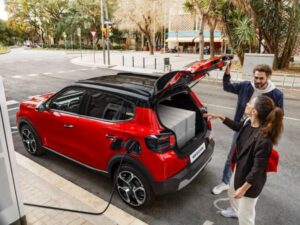
Vauxhall has released new Freedom of Information research showing that 38% of UK councils provide no on-street EV charging suitable for disabled drivers.
The findings revealed that 111 of the 289 councils surveyed said they have no on-street charge points that have been specifically adapted for disabled drivers. None follow the British Standards Institution’s Publicly Available Specification (PAS) 1899:2022 either.
PAS 1899:2022 is a national accessible charging standard. It’s co-sponsored by the Motability Foundation and the UK Government.
The FOI findings follow 2024 research released by Vauxhall. That study assessed the considerations being given towards disabled drivers by local authorities when installing on-street residential charge points.
Charging Infrastructure Remains Unchanged
The most recent EV charging accessibility data shows there’s been no change in the number of on-street chargers adapted for disabled drivers – just 2.2% across the UK.
This comes despite latest figures from the Department for Transport showing a 27% year-on-year increase in the number of on-street chargers across the country as of the end of April this year.
Further EV charging issues facing disabled motorists include obstructions to charge points. Charge points placed too close to kerbs create problems. Heavy cables make access difficult for wheelchair users.
Vauxhall is also a leading supplier of EVs to the Motability Scheme. With over 16 million disabled people in the country, research from the Motability Foundation predicts that 1.35 million disabled motorists will be partially or fully reliant on public charging infrastructure by 2035.
Additional information published by the Motability Scheme’s EV transition tracker highlighted the issues disabled drivers face in the transition to EVs.
It shows that 65% of its customers will only make the shift from diesel or petrol to electric when they have to. Moreover, 45% of respondees said it’s too difficult to find nearby public charging points.
Electric Streets Campaign
All of the EV charging accessibility findings were part of Vauxhall’s ‘Electric Streets of Britain’ campaign. The initiative aims at making EV infrastructure accessible and improving on-street charge points for drivers who wish to make the switch to an EV but don’t have a home charger.
Steve Catlin, managing director at Vauxhall, commented: “Limited access to public charging is known to be a barrier for Britain’s disabled motorists wishing to switch to EVs – particularly those who have no home charging capability.”
“The number of councils who do not provide charging provisions specifically for those with disabilities, as highlighted in our new research, is concerning – we need to ensure that all drivers, wherever they are, can easily find and access charge points if we are hoping to bring all drivers on the UK’s electrification journey.”
Catlin explained that through Electric Streets of Britain, Vauxhall continues to encourage drivers to register their need for on-street charging near them. Disabled drivers can also say where they require specific accessible charging.
“As the number of on-street chargers continues to rise, we want to see the number of chargers which have been adapted for disabled drivers to grow alongside this – all drivers should be able to access public charging, whatever their need, to ensure going electric is a practical and viable option.”
Andrew Miller, the chief executive of Motability Operations responsible for running the Motability Scheme added: “We need to make sure disabled people aren’t left behind as the UK transitions to EVs. We hear from our customers every day and many of them tell us the same thing.”
“They’re struggling with the change, and public charging is their biggest worry. This uncertainty is stopping people from making the switch – and could lead to a cliff edge transition that leaves thousands of disabled people with no access to mobility.”