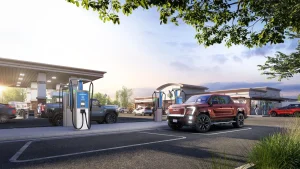
Tesla’s Public Supercharger network has claimed the top spot in the UK’s annual charging network rankings for the second consecutive year, according to Zapmap’s driver satisfaction survey.
The survey, which polled nearly 4,000 EV drivers, ranked Tesla highest in the “Large” category with an overall score of 4.8 out of five. The network outperformed competitors including MFG EV Power, Ionity and Osprey across five key criteria – reliability, ease of use, customer support, value for money and ease of payment.
Tesla first appeared in the rankings in 2024 after opening some Supercharger locations to non-Tesla vehicles.
The company has now made 1,115 chargers at 97 locations accessible to drivers of other EV brands. That represents around 54% of Tesla’s entire UK network.
MFG EV Power finished second with a score of 3.9 out of five. The network has expanded rapidly, growing 68% in the past year to more than 1,300 devices at 522 locations. Drivers praised its ease of use, reliability and payment options.
Ionity moved from the Medium to Large category for 2025 and tied with Osprey for third place. Ionity has more than doubled in size since last year, operating 536 devices across 58 locations. Drivers highlighted its reliability and payment flexibility, while Osprey matched Tesla for the highest customer service rating.
Medium Networks Show Strong Performance
Sainsbury’s Smart Charge topped the Medium category with 4.4 out of five. The network launched in January 2024 and was previously named Zapmap’s “Up-and-Coming” network.
Smart Charge has grown 40% over the past year to 335 rapid or ultra-rapid chargers at 84 locations. Drivers particularly appreciated its ease of use and reliability.
Be.EV finished second in the medium category with 4.3 out of five, dropping from the large category after reducing to 406 devices. Fastned claimed third place with 4.2 out of five, operating 199 devices at 34 locations as part of its measured UK expansion.
Arnold Clark Charge received this year’s Up-and-Coming network designation. The car retailer opened its on-site chargers to the public earlier this year and scored well across all criteria.
The network currently operates more than 250 devices across 57 locations – with plans to expand to over 500 devices at 100 locations.
Industry Satisfaction Rises Despite Cost Concerns
Overall satisfaction with public charging infrastructure improved from 64% to 69% year-over-year, according to Zapmap’s research.
Melanie Shufflebotham, co-founder and COO at Zapmap, said the rankings provide direct feedback from EV drivers about network reliability and industry priorities.
“Overall satisfaction with the public charging infrastructure has improved – from 64% last year to 69% this year – which is also reflected in the increasing scores across the reliability indicator, the key consideration for drivers.”
Cost remains a significant concern. Most networks received their lowest scores for value for money, with only a couple of exceptions performing well in this category.
More than 60% of drivers expect continued improvements to the public charging network, according to the survey.
Several networks struggled in the rankings. ChargePlace Scotland scored just 2.1 in the large category, while BP Pulse managed only 2.4 and Shell Recharge received 2.6. These were the only large operators failing to score at least 3.5 out of five.
In the medium category, Geniepoint finished last with 2.4, followed by ESB Energy on 2.7 and Lidl on 2.9.
Despite these poor performers, 10 of the 19 networks scored highly enough to earn “EV driver recommended” status.
Vicky Edmonds, CEO of drivers’ group EVA England, emphasized the importance of user experience for EV adoption success.
“With two thirds of EV drivers believing that the public charging network is showing ongoing signs of real improvement, those operators that are focusing on their reliability, accessibility and affordability can pave the way for the sector as a whole.”
The annual Zapmap research examines rapid and ultra-rapid charging networks, categorizing operators with more than 500 devices as “Large” and those with 150-500 chargers as “Medium.”