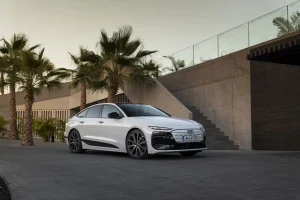
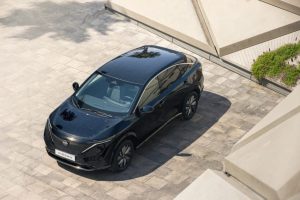
Ferrari has revealed its first dedicated electric vehicle after six years of development. The Italian automaker unveiled the Luce – meaning ‘light’ in Italian – with Formula 1 drivers Charles Leclerc and Lewis Hamilton removing the covers at an event in Rome.
The four-door electric vehicle produces 1,036 horsepower from four electric motors and offers a 329-mile range from its 122kWh battery pack.
Ferrari expects the Luce to reach continental European markets in early 2027 with pricing around €500,000. UK deliveries will follow that spring with a £440,000 starting price.
Quad-Motor Setup Delivers Track Performance
The Luce uses a rear-biased four-motor configuration that generates 739 lb-ft of total torque. The rear motors each produce 416 horsepower and 262 lb-ft, while the front units contribute 141 horsepower and 103 lb-ft each.
Ferrari’s engineers developed the radial flow permanent magnet motors using technology from the company’s Le Mans-winning 499P prototype and the F80 hypercar’s hybrid system.
The electric Ferrari accelerates from 0-62 mph in 2.5 seconds and reaches a top speed of 192 mph.
In-wheel motor technology enables torque vectoring for improved handling. The system operates in all-wheel-drive mode during Tour and Performance settings but switches to rear-wheel-drive in Range mode by disconnecting the front motors.
In-House Battery Technology
Ferrari designed and manufactures the 122kWh battery pack at its Maranello facility. The unit integrates into the vehicle’s floorpan and weighs 630 kilograms – representing 29% of the Luce’s total 2,269kg weight.
The company’s 800V electrical architecture supports ultra-rapid charging at speeds up to 350kW.
Ferrari achieved the 329-mile range figure through aerodynamic optimization and efficient power management systems.
Apple Veterans Design Ferrari’s First Four-Door
The Luce marks Ferrari’s first four-door, five-seat model in the company’s 86-year history. Rather than working with traditional Italian design houses Pininfarina or Bertone, Ferrari enlisted LoveFrom – the agency founded by former Apple design chief Sir Jony Ive and Marc Newson.
Ive led the design teams behind the iPhone, iPad, and iMac during his tenure at Apple.
The aluminum-bodied Luce measures five meters long by 1.9 meters wide and takes the form of a raised fastback – similar in concept to the Polestar 4 rather than an SUV like Ferrari’s Purosangue.
A two-piece floating glass roof sits above the minimalist body, which features floating spoilers front and rear. Ferrari claims the Luce achieves the lowest drag coefficient of any vehicle in its lineup, though specific figures weren’t disclosed.
The design won’t influence Ferrari’s other models – traditional styling will continue across the non-electric range.
With a 597-liter cargo area, the Luce offers more practical storage than any previous Ferrari.
iPad-Inspired Interior Blends Digital and Physical Controls
The cabin reflects the designers’ Apple heritage through extensive use of aluminum and strengthened glass. A movable 10-inch central touchscreen bears clear resemblance to an iPad in both appearance and functionality.
A unique clock sits in the screen’s top right corner, featuring physical dials with a digital face that converts between compass and lap timer functions.
Breaking from current automotive trends, Ferrari retained significant physical switchgear throughout the cabin. Climate control, infotainment, and other vehicle functions use traditional buttons and switches rather than touchscreen menus.
The 12.5-inch driver display combines three separate analog-style dials created using custom Samsung OLED screens layered with convex glass for a traditional gauge appearance.
What appears to be black plastic surrounding the driver area is actually an OLED screen displaying warning lights, navigation instructions, and the shift lights typically mounted atop Ferrari steering wheels.
The central digital speedometer uses a physical needle, while the manettino switches flanking the steering wheel remain mechanical controls for drive modes and powertrain settings. Steering wheel paddles manage torque delivery rather than gear changes.
Ferrari designed the three-spoke steering wheel as a tribute to the Nardi units fitted to iconic Maranello cars from the company’s history.
A floating center console finished in leather and glass houses physical controls for the trunk, windows, and central locking. The aluminum and glass key stores in a dedicated holder on the console’s front face.
Launch control activates via a roof-mounted grip above the driver’s position, flanked by toggle switches for exterior lighting and window defrosting systems.
The Luce represents Ferrari’s most significant departure from tradition while maintaining the performance benchmarks expected from the brand.